GuidesLast updated 3 November 20267 min read
How to stop procrastinating: why you put things off and how to start
To stop procrastinating, make the task smaller and more concrete, give it a time, and remove the easiest escape: write down the very next action, agree to work on it for just 10 minutes, put it on the calendar at a set hour, and leave your phone in another room. Procrastination is rarely laziness. It is avoiding the bad feeling a task gives you, which is why fixing that feeling (vague, boring, scary, too big) works better than more willpower. And when you slip, forgive yourself and plan the next start, because guilt makes the next delay more likely.
Why you procrastinate, and why it is not laziness
Procrastination is putting off something you intend to do, even though you expect the delay to make things worse. That last part is what separates it from rest or from sensible prioritizing. You know the report is due on Friday, you know Thursday night will be awful, and you open your email anyway.
Psychologists who study it, such as Tim Pychyl and Fuschia Sirois, describe procrastination as a way of managing mood, not time. The task brings up a bad feeling (boredom, confusion, self-doubt, dread), and putting it off makes that feeling go away at once. The relief rewards the delay, so next time it comes even quicker. That is why a better calendar alone rarely fixes it: the problem starts before the plan.
Pychyl lists the traits that make a task more likely to be put off: boring, frustrating, difficult, ambiguous, unstructured, not rewarding in itself, or lacking personal meaning. Most dreaded tasks tick three or four. Each trait has a fix, which is better news than "try harder".
Find out what you are avoiding
Before choosing a technique, ask what exactly feels bad about the task. Two minutes of honesty here saves an afternoon of trying the wrong fix.
| If it sounds like | What is usually behind it | What to try |
|---|---|---|
| "I do not know where to start" | The task is vague | Write the very next physical action |
| "It is so boring" | No reward until the end | A 25-minute timer and a small treat after |
| "It has to be perfect" | Fear of being judged | Write a bad first draft on purpose |
| "It is too big" | No finish line in sight | Cut off a piece you can finish today |
| "I work better under pressure" | The deadline is far away | Set an earlier deadline someone else sees |
| "I just end up on my phone" | The easiest escape is in your hand | Put the phone in another room |
How to stop procrastinating, step by step
- Pick one task you are avoiding today. One, not the whole list: a page of dreaded tasks is its own reason to look away.
- Write the next physical action. Not "taxes" but "find last year's tax PDF in my email". If you cannot picture your hands doing it, it is still too vague.
- Shrink it until starting feels almost silly: write one sentence, or work for 10 minutes and then you may stop. Most of the resistance sits before the first minute.
- Decide when and where, in one sentence: "At 9:00, at my desk, before I open email, I write the outline." Peter Gollwitzer's research on implementation intentions found that a plan with a when and a where gets followed through more often than a plain intention.
- Remove the easiest exit for those 10 minutes: phone in another room, one window open, notifications off.
- Start before you feel like it. Waiting to feel motivated rarely works; the willingness usually turns up a few minutes after you begin.
- When the 10 minutes are up, stop or do another round. Either way the task is no longer untouched.
Do not wait to feel ready. Make the first step so small that feeling ready is not required.
Give the task a time, not just a place on a list
A task that lives only on a list competes with everything else on it, every hour of the day, and the easiest one usually wins. A task with a time has already won that argument. That is the core of time blocking: fixed things first, then the work, each with a start time and a length.
- Put the dreaded task first. Early in the day, before messages pile up, there are fewer excuses within reach and less time for the dread to grow.
- Keep the block short. 25 to 45 minutes for something you have been avoiding. A Pomodoro round of 25 minutes is a good default, and you can always book a second one.
- Move deadlines closer. A deadline three weeks away barely registers. Break the work into pieces with their own dates, and tell someone when the first one is due.
Make the easy escape harder
Willpower is a poor fence. It is easier to change the room than to resist it for an hour.
- Phone out of reach. Not face down on the desk: in a drawer, a bag or another room. If the phone is where the time goes, blocking the apps that pull you in during work hours is the stronger version.
- One window. Close the tabs that have nothing to do with the task. A browser full of open conversations is an invitation.
- Company. Working alongside someone else, in person or on a video call, makes it easier for many people to start and keep going. The ADHD community calls it body doubling, and it works for plenty of people without ADHD too.
- A reward you can see. Pair the boring task with something you like: a coffee you only have while doing invoices, a podcast for cleaning, a walk after the first hour.
What to do after a day you put everything off
Guilt feels like responsibility, but it tends to backfire: the task now carries yesterday's bad feeling as well, so it is even easier to avoid. In a well-known study at Carleton University, students who forgave themselves for procrastinating before a first exam procrastinated less when studying for the next one. Self-forgiveness is not letting yourself off the hook. It clears the way back to the task.
- Close the day in five minutes. Move the task to a specific time tomorrow, not just "tomorrow". A shutdown ritual makes this a habit.
- Make it smaller, not later. If it did not happen today, the step was too big. Cut it in half before you put it back on the calendar.
- Watch the repeats. A task moved three days in a row needs a decision: split it, ask for help, hand it to someone else, or admit it does not matter and delete it.
When it is more than procrastination
Putting things off now and then is normal. But if you avoid almost everything for weeks, including things you used to enjoy, or the delays are hurting your work, studies or health, it may be a sign of something else, such as ADHD, depression, anxiety or burnout. This is practical advice, not medical advice: a doctor or psychologist can help you find out what is going on, and our guide to planning your day with ADHD covers time blindness and getting started.
Apps that help, and what they cannot do
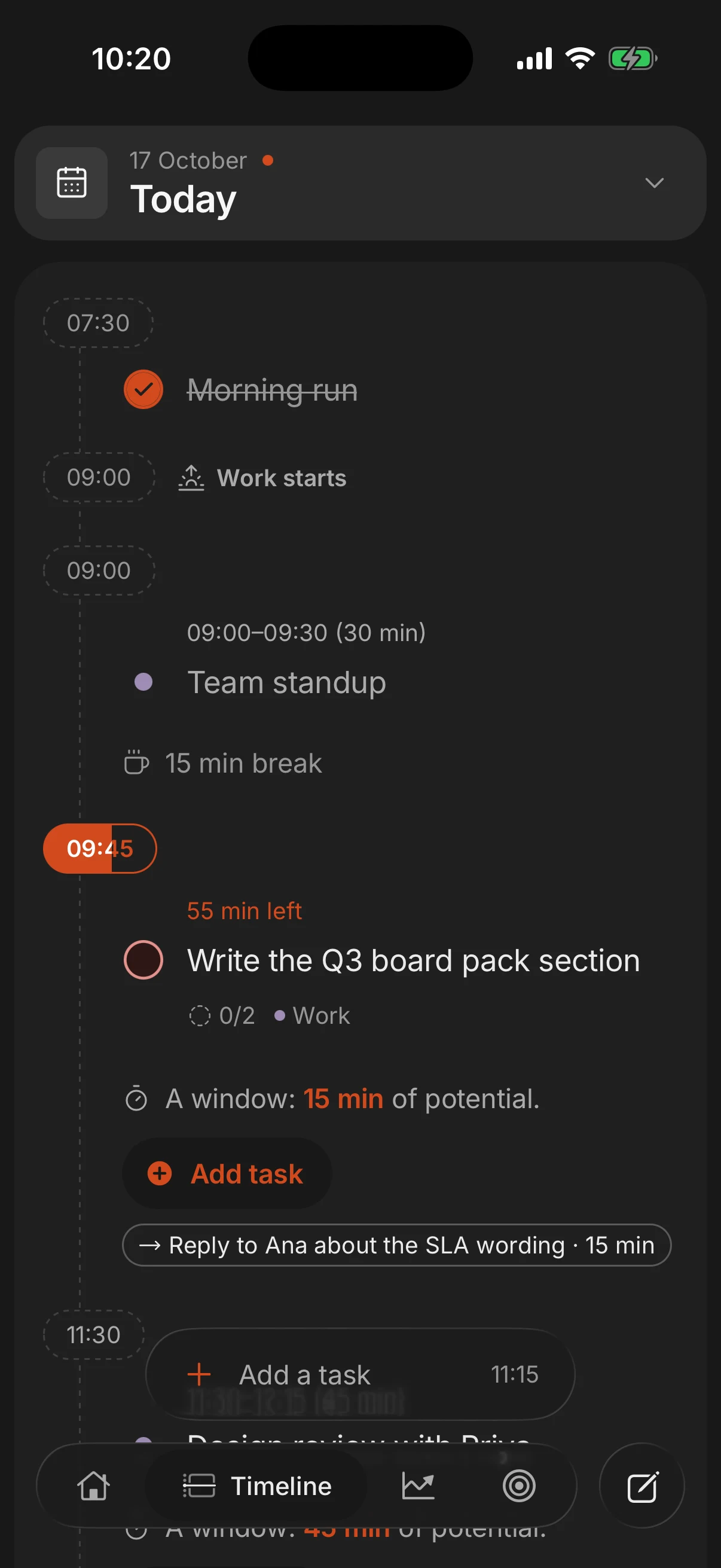
No app will make you want to do your taxes. What a good tool can do is take the effort out of the steps above: capturing the next action in seconds, giving it a time, reminding you when that time comes, and moving it forward without a wall of overdue tasks when the day goes badly.
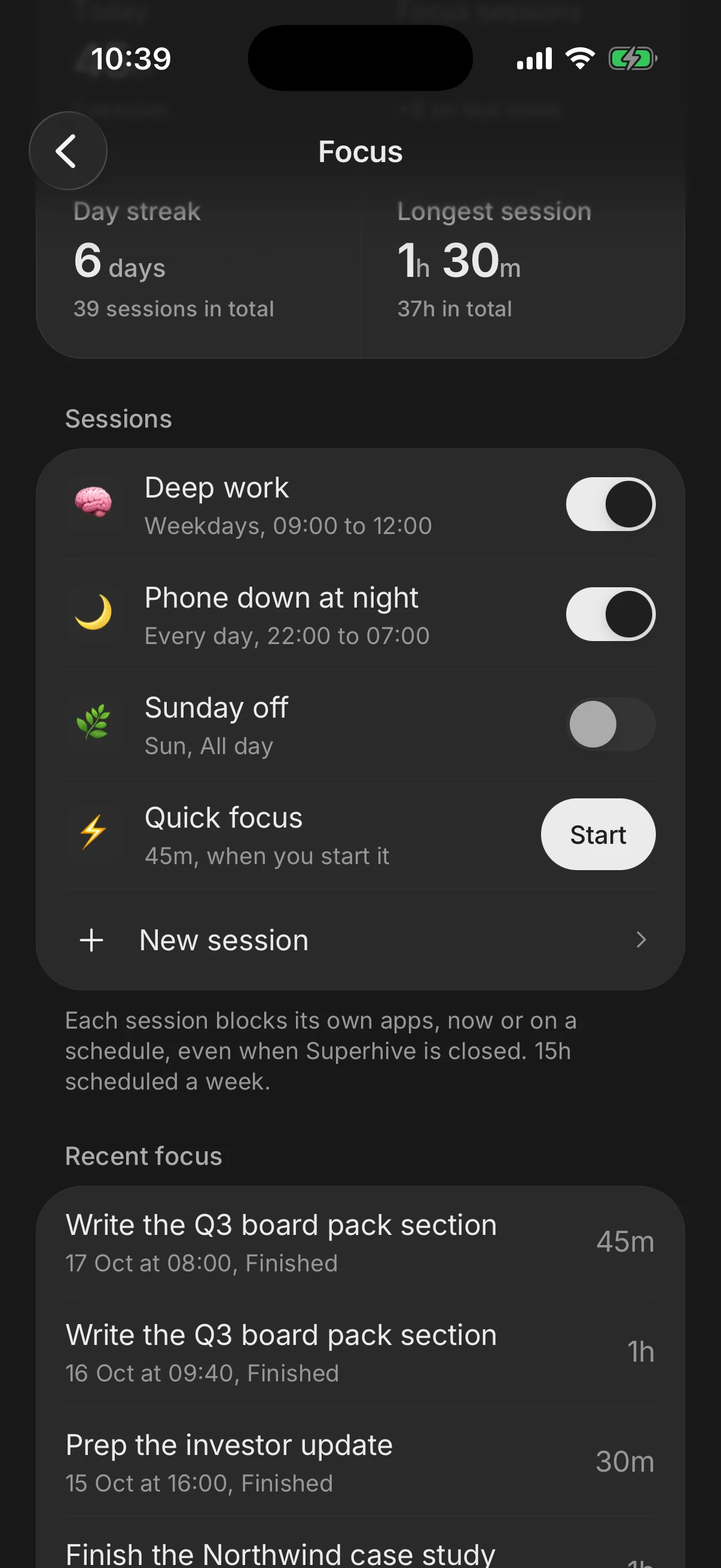
Superhive handles those parts. Type a task in plain words, like "outline the report tomorrow 9am", and the date and time are read for you; give it a length and it lands on your day as a block in the free time around your events, with a reminder if you want one. The daily shutdown moves what did not get done to tomorrow, and the progress screen keeps a streak and a weekly momentum score compared only with your own past weeks. On Pro, a focus session times the task in front of you, and on iPhone Super focus blocks the apps you choose while it runs.
Questions people ask
Is procrastination a sign of laziness?
Usually not. A lazy person is happy doing nothing; a procrastinator often feels guilty and keeps busy with other things instead. It is a way of avoiding a bad feeling, and it responds to fixing that feeling, not to more effort.
What is the two-minute rule?
There are two versions. David Allen's says to do anything that takes under two minutes right away. James Clear's, from Atomic Habits, says to scale a new habit down until it takes two minutes to start. Both lower the cost of beginning.
How do I stop procrastinating on my phone?
Keep it out of reach while you work, turn off notifications from the apps that pull you in, and if that is not enough, block them during set hours. Our guide to blocking distracting apps on iPhone covers the free options.
How do I stop procrastinating when studying?
Give each session a concrete target, such as 10 pages or one problem set, and a time. Study in rounds of 25 minutes with the phone in another room. A study plan for the week means each session starts without a decision.
Can procrastination be a sign of ADHD?
It can be one sign among several, but procrastination alone does not mean ADHD. If trouble starting, keeping track of time and finishing things has followed you since childhood and affects your life, talk to a doctor or psychologist.
Keep reading
- Time blocking: how to plan your day in blocksTime blocking gives every task a start time and a length on your calendar. How to do it in 10 minutes a day, with an example day and the mistakes to avoid.
- The Pomodoro technique: how it works and who it suitsThe Pomodoro technique: 25 minutes on one task, a 5-minute break, a longer one after four. How to do it, the 50/10 and 90-minute variations, and who it suits.
- How to block distracting apps on your iPhone to focusBlock distracting apps on iPhone for free with Screen Time and Focus, why those limits are so easy to skip, and when a dedicated app blocker is worth it.
- How to plan your day with ADHD, and what to look for in a plannerHow to plan a day with ADHD: make time visible, get everything out of your head, plan short blocks, set alerts before transitions and roll over what is left.