GuidesLast updated 2 November 20267 min read
The Pomodoro technique: how it works and who it suits
The Pomodoro technique is a way of working in timed rounds: 25 minutes on one task, then a 5-minute break, and a longer break of 15 to 30 minutes after every four rounds. Francesco Cirillo developed it as a university student in the late 1980s, using a tomato-shaped kitchen timer, which is where the name comes from. It works best for tasks you keep putting off and for days full of small interruptions, and worst for long deep work, where a bell every 25 minutes breaks the flow.
What the Pomodoro technique is
Pomodoro is Italian for tomato. Cirillo's starting point was a small challenge to himself: could he focus on studying for a short, fixed stretch without drifting? The kitchen timer made that promise physical, and the round eventually settled at 25 minutes. Each round is called a pomodoro, and the method counts work in pomodoros instead of hours.
The timer is the visible part, but the method rests on two rules. A pomodoro is for one task, and it is indivisible: if you abandon it halfway, it does not count and you start a fresh one. And distractions get written down, not acted on. The full method, described in Cirillo's book and on the official site, also covers choosing the day's work, estimating effort in rounds and recording how the day really went.
How to do the Pomodoro technique, step by step
- Pick one task and name it precisely: "write the introduction", not "work on the report".
- Set a timer for 25 minutes. If the timer is not your phone, put the phone face down or in another room.
- Work only on that task until it rings. When another thought arrives (an email to send, something to buy), write it on a sheet next to you and go straight back.
- When the timer rings, stop, even mid-sentence, and mark a cross on the sheet. That cross is one pomodoro.
- Take a 5-minute break away from the task: stand up, drink water, look out of a window. Not email, which rarely stays at five minutes.
- After four pomodoros, take a longer break of 15 to 30 minutes.
- At the end of the day, count the crosses. After a week you will know how many real rounds your day holds, which is usually fewer than you expect.
One task, one timer, one cross. Everything else that comes up goes on paper until the break.
What to do when you get interrupted
Interruptions are where most people give up on the method, so Cirillo gave them their own rules.
- Internal interruptions, the urge to check something or a sudden idea, go on the sheet. You deal with them at the break or later. Once an urge is written down it usually loses its pull.
- External interruptions, a colleague or a call, get a three-step answer: tell the person you are in the middle of something, agree when you will get back to them, and then do it. Most requests can wait 15 minutes.
- If you have to stop, the pomodoro is void. Do not pause it and resume later; start a new one when you are back. Note the broken round, because a pattern of them tells you something about your day.
- If you finish early, use the rest of the round to review or improve what you just did instead of starting something new.
Variations: 50/10, 90 minutes and shorter rounds
Cirillo's numbers are a starting point. What makes it work is a fixed round, a real break and one task per round. These are the variations people use most:
| Rhythm | Work | Break | Good for |
|---|---|---|---|
| Classic | 25 minutes | 5, then 15 to 30 after four | Starting, studying, admin |
| 50/10 | 50 minutes | 10 minutes | Writing, coding, design |
| 90-minute block | 90 minutes | 15 to 20 minutes | Deep work, once focus holds |
| Short rounds | 10 to 15 minutes | 2 to 5 minutes | Dreaded tasks, low-energy days |
The 50/10 rhythm suits work that needs a warm-up, because the first minutes of every round go into getting back into the problem. The 90-minute block is often linked to the body's roughly 90-minute cycles of rest and activity; treat that as a rule of thumb, not settled science. Short rounds are the opposite tool: when a task feels impossible to start, 10 minutes is small enough to agree to, and starting is usually the hard part.
Who it suits and who it does not
It tends to work well if:
- You keep putting off one task. Twenty-five minutes is easier to agree to than "finish the tax return".
- You study or review material, where regular breaks help you come back to it fresh.
- You lose track of time, either drifting between tabs or working three hours without standing up.
- You have a pile of small tasks. Four rounds of admin clear more than an afternoon of half-attention.
It is a poor fit if:
- Your work needs long, unbroken focus. Programmers, writers and designers in flow often find a bell at 25 minutes does more harm than good. Try 50/10 or 90 minutes, or let the timer ring and carry on when it is going well.
- Your job is made of interruptions: support, reception, a day at home with small children. Most rounds will be void. Short rounds, or saving the work for the quiet hours, suit you better.
- Your day is mostly meetings. There is little to put in rounds, and the effort is better spent protecting one free block.
- A ticking clock makes you anxious. Some people work worse while watching time run out. That is a reason to drop the timer, not to push harder.
Combining it with time blocking
The two methods answer different questions. Time blocking decides when each task happens and how long it gets. The Pomodoro technique decides how you work inside that time. Together they turn "write the proposal, 9:00 to 11:00" into four rounds you can actually start.
The arithmetic is simple. A 2-hour block holds four pomodoros and three short breaks, 1 hour 55 minutes in total, followed by the long break. A 90-minute block holds three, which is 85 minutes. Counting in rounds also exposes overloaded days: if your blocks add up to 16 pomodoros and last week you managed 10 a day, the plan will not hold.
Cirillo's rule for sizing tasks fits here too. Anything that needs more than five to seven pomodoros is too big and should be split into smaller tasks. Anything under one should be grouped with similar small tasks into a single round.
Timers and apps
Any timer works. A kitchen timer is the original and has the advantage of not being a phone. The timer in your phone's clock app is fine too, as long as picking up the phone does not pull you into notifications; turning on Do Not Disturb for the round helps. Dedicated Pomodoro apps count rounds and breaks for you, and some task managers, such as TickTick, include a Pomodoro timer.
If the phone itself is the distraction, a timer is not enough on its own. Our guide on how to block distracting apps on your iPhone covers the free settings and the apps that go further.
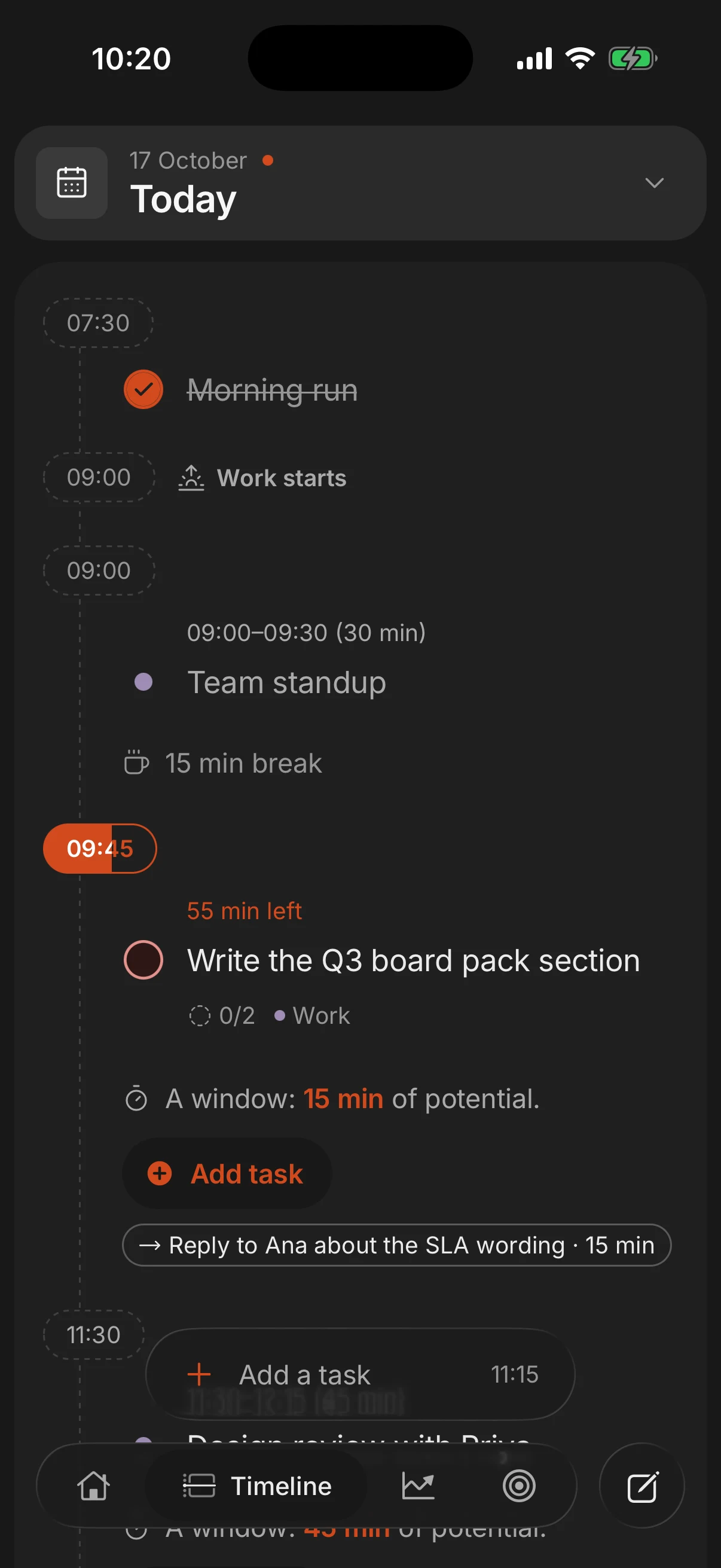
Superhive covers the planning half of this. Give a task a length and it lands on the day as a block in the free time around your events, so you can see how many rounds the day really holds. On Pro, a focus session times one task, and on iPhone Super focus can block the apps you choose while it runs. It is not a Pomodoro timer: it does not count rounds or schedule the long break after four, so if counting rounds is what keeps you going, keep a dedicated timer next to it.
Questions people ask
Why is a pomodoro 25 minutes?
It is long enough to make real progress and short enough to start without dread, which is where Cirillo's experiments settled. Nothing is magic about the number: many people move to 50 minutes once the habit holds.
What should I do during a Pomodoro break?
Rest the part of you that was working: stand up, walk, get water, look at something far away. Avoid email and social media, which rarely end after five minutes.
Does the Pomodoro technique work for studying?
Yes, it is one of its most common uses. Give each round a concrete target, such as one problem set or 10 pages, and use the long break to eat or move. Our study planner guide covers planning the whole week.
Is the Pomodoro technique good for ADHD?
Many people with ADHD find short, timed rounds make starting easier, while others find the bell breaks a good stretch of focus. Rounds of 10 to 15 minutes are worth trying. See planning your day with ADHD for more.
Can I pause a pomodoro?
In Cirillo's method, no. A round you stop is void, and you start a new one when you come back. Knowing that a pause breaks the round makes it easier to protect.
How many pomodoros a day is realistic?
There is no standard number. Count yours for a week and plan with the average, which is usually well below the hours you spend at your desk.
Keep reading
- Time blocking: how to plan your day in blocksTime blocking gives every task a start time and a length on your calendar. How to do it in 10 minutes a day, with an example day and the mistakes to avoid.
- How to block distracting apps on your iPhone to focusBlock distracting apps on iPhone for free with Screen Time and Focus, why those limits are so easy to skip, and when a dedicated app blocker is worth it.
- How to organize your studies: a study schedule that worksPlan backwards from exam dates, use spaced repetition and active recall, and turn it into a weekly study schedule. With a sample week for exam season.
- How to plan your day with ADHD, and what to look for in a plannerHow to plan a day with ADHD: make time visible, get everything out of your head, plan short blocks, set alerts before transitions and roll over what is left.