GuidesLast updated 2 November 20267 min read
How to organize your studies: a study schedule that works
To organize your studies, start from your exam and deadline dates and plan backwards: list the topics, spread them over the weeks you have, and come back to each one several times instead of cramming it once. Fill your study blocks with active recall, testing yourself rather than rereading, and give those blocks fixed times on a weekly schedule around classes and work. A good study plan keeps the last few days before each exam for practice tests and tells you, on any given day, exactly what to study.
Start with your dates, not a timetable
Most study schedules fail because they start with a colorful weekly grid and no idea of what has to be done by when. Start with the hard dates of the term instead, all on one page or one calendar:
- Exams, with what each one covers and how much it counts toward the grade.
- Deadlines: essays, problem sets, lab reports, presentations.
- Your fixed week: classes, work shifts, commuting, sport, family time.
- Your real study hours. A common university guideline is about two hours of study outside class for each hour in class. Take that as a starting point, then be honest about what your week allows.
Once the dates are visible, the semester stops being one long blur and becomes a handful of crunch points you can see coming.
Plan backwards from each exam
- List the topics. Use the syllabus, the course outline or past papers. A typical semester course might have 10 or 12.
- Size each topic. Mark it small, medium or large, or estimate the sessions it needs. Topics you find hard get more.
- Protect the end. Keep the last 3 to 5 days before the exam for full practice tests and fixing mistakes, not new material.
- Spread the first pass. Divide the topics across the weeks that remain, so each week has a fixed set to learn for the first time.
- Schedule the returns. After the first pass, come back to each topic a few days later, then about a week later, then two or three weeks later. Those returns matter more than the first pass.
- Set milestones. "Topics 1 to 4 done by week 3" and "first full past paper by week 6" tell you early whether you are behind, while there is still time to fix it.
Spaced repetition and active recall, in plain terms
Two findings come up again and again in learning research, and they should decide what happens inside every study block.
- Spaced repetition. You forget quickly after first learning something, and each review at a growing interval makes it last longer. Three 1-hour sessions spread over two weeks usually beat one 3-hour session the night before, even though the total time is the same.
- Active recall. Pulling an answer out of memory strengthens it far more than reading it again. Rereading and highlighting feel productive because the material looks familiar, but familiar is not the same as remembered.
In practice, active recall looks like this:
- Close the book, write down everything you remember about the topic, then check what you missed.
- Turn your notes into questions and answer them a few days later without looking.
- Use flashcards, on paper or in an app like Anki, which schedules the reviews for you.
- Do practice problems and past papers against the clock.
- Explain the topic out loud as if you were teaching a friend.
Study blocks: how long, when and how many
- Length. 45 to 90 minutes per block, with a short break between blocks. If concentration is hard, split a block into 25-minute rounds with the Pomodoro technique.
- One subject and one target per block. "Statistics" is not a block. "Statistics: 10 practice problems on probability" is.
- Hard subjects in your best hours. For many students that is the morning; for others it is late afternoon. Use your most alert hours for new or difficult material and the flatter ones for flashcards.
- Mix subjects across the week. Alternating subjects, instead of spending a whole day on one, gives each topic natural gaps for spaced review.
- Phone in another room. Notifications break concentration even when you do not answer them. If willpower is not enough, block distracting apps while you study.
- Protect sleep. Much of what you studied is consolidated while you sleep. An all-nighter before an exam trades away the very thing that makes the studying stick.
A sample weekly study schedule
Here is a week for a student with classes in the morning, four weeks before two exams: statistics and history. It adds up to about 14 hours of study on top of classes.
| Day | Block 1 | Block 2 | Quick review |
|---|---|---|---|
| Monday | 14:00 to 15:30 Statistics: new topic | 16:00 to 17:00 History: turn chapter 5 into questions | 15 min flashcards |
| Tuesday | 14:00 to 15:30 History: answer last week's questions from memory | 16:00 to 17:00 Statistics: 10 practice problems | 15 min flashcards |
| Wednesday | 14:00 to 15:30 Statistics problem set, due Thursday | Gym | 15 min flashcards |
| Thursday | 14:00 to 15:30 Statistics: redo Monday's topic, closed book | 16:00 to 17:00 History: new chapter | 15 min flashcards |
| Friday | 14:00 to 15:00 Timed section of a past paper | 15:15 to 16:00 Mark it, list the mistakes | Off |
| Saturday | 10:00 to 12:00 Mixed review of the week | Off | Off |
| Sunday | Off | 20 min: plan next week | Off |
Notice what the table does: every block names a subject and a task, statistics comes back three times, nothing new is learned on Friday or Saturday, and Sunday has 20 minutes to plan the next week. If you work, drop to one block on weekdays and start a week earlier.
Keeping it going all semester
- Review the plan every Sunday. Check the milestones, move what slipped and set next week's blocks. 20 minutes is enough; our weekly planning guide has the routine.
- Keep one buffer block a week. Something will run over: a problem set, a sick day, a shift you could not swap.
- When you fall behind, cut instead of cramming. Drop low-weight topics, or cover them with past-paper questions only, rather than piling everything into the final week.
- Start the next exam early. When exams cluster, the one in week 14 needs its first pass in week 8, not week 13.
Study the way the exam tests you. If it asks you to recall and solve, your study blocks should be recalling and solving, not rereading.
Paper, a spreadsheet or an app
A paper planner and a wall calendar with the exam dates circled are enough for many students. A spreadsheet works well for the topic list and its review dates, and flashcard apps handle the spacing of single facts. What none of them does on its own is connect the exam, its topics and this week's study blocks.
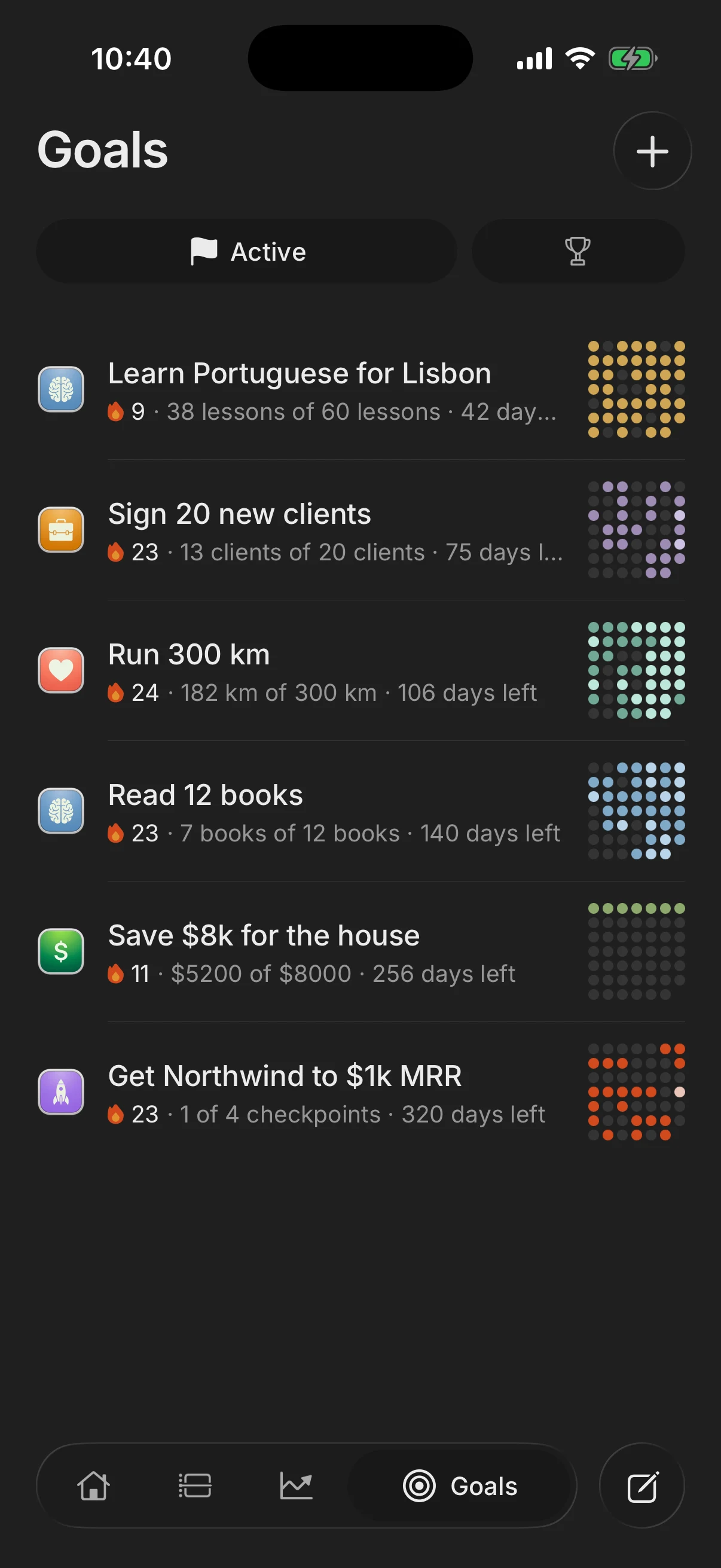
In Superhive you can set each exam up as a goal with its date and break it into milestones, such as groups of topics and practice papers, with a pace that shows whether you will get there in time. Study sessions sit under the goal as tasks with a length and land on your day as blocks around everything else, with a reminder when they start. All of that is free. Pro adds what helps in exam season: recurring tasks for weekly reviews, your classes on your day if they are in Google Calendar or your phone's calendar, focus sessions with a timer and, on iPhone, Super focus, which blocks distracting apps while you study. A study group can also share a goal and assign each other tasks.
Questions people ask
How many hours a day should I study?
It depends on your course load, but 2 to 4 focused hours on study days do more than 8 distracted ones. How you spread the hours across the week matters more than the daily total.
How far in advance should I start studying for an exam?
For a major final, start the first pass 3 to 5 weeks out so every topic gets at least two reviews. For a smaller test, a week with 3 or 4 short sessions usually beats one long night.
What is the best way to memorize for an exam?
Active recall with spacing: flashcards, practice questions and explaining topics out loud, repeated over several days. Rereading and highlighting feel productive but help much less.
Is it better to study in the morning or at night?
Study hard material in the hours when you are most alert, which varies from person to person. Whatever the hour, do not trade away sleep, since much of what you study is consolidated overnight.
How do I make a study schedule if I also work?
Put work shifts and classes in first, then plan fewer, shorter blocks, for example one hour on weekdays and one longer block on the weekend. Start each exam's first pass earlier to make up for fewer hours a week.
Does the Pomodoro technique work for studying?
For many students, yes: 25 minutes of focus and a 5-minute break makes starting easier. See the Pomodoro guide for how to fit rounds into study blocks.
Keep reading
- How to break down goals into tasks you actually doBreak a goal into milestones, a weekly pace and one next task with a day and a time. A step-by-step method, a worked example and why most goals stall.
- The Pomodoro technique: how it works and who it suitsThe Pomodoro technique: 25 minutes on one task, a 5-minute break, a longer one after four. How to do it, the 50/10 and 90-minute variations, and who it suits.
- Time blocking: how to plan your day in blocksTime blocking gives every task a start time and a length on your calendar. How to do it in 10 minutes a day, with an example day and the mistakes to avoid.
- How to block distracting apps on your iPhone to focusBlock distracting apps on iPhone for free with Screen Time and Focus, why those limits are so easy to skip, and when a dedicated app blocker is worth it.