GuidesLast updated 2 November 20267 min read
How to plan your week: a 30-minute weekly planning session
To plan your week, set aside 20 to 30 minutes once a week, usually Friday afternoon or Sunday evening, and do four things in order: look back at last week, look ahead at the fixed commitments of the next one, choose two or three priorities that move your goals forward, and give each of them rough blocks of time on specific days. Do not schedule every hour. The weekly plan decides what matters and roughly when; each morning's daily plan decides the exact hour.
Why plan by the week
A day is too short to plan real work in. A project that needs six hours does not fit into any single day, and a day that goes wrong has nowhere to send what it could not hold. A month is too long: by the third week, the plan describes a different month. The week is the unit where big work can be split across days and where a bad Tuesday can still be fixed on Thursday.
Weekly planning also catches collisions while you can still do something about them: two deadlines on the same Thursday, a trip that eats Wednesday, a day with five hours of meetings. And it is where goals turn into tasks. Without it, daily planning tends to fill each day with whatever is most urgent, and the work that matters but has no deadline never gets a slot.
The session at a glance
Pick a fixed slot and put it on your calendar as a repeating event. Friday afternoon works well for work: the week is fresh in your mind and you leave knowing how Monday starts. Sunday evening suits people who plan work and personal life together. Monday morning is the fallback, not the default, because Monday mornings have a way of filling themselves. Have your calendar, your task list and your goals open, and expect the first two or three sessions to take closer to 45 minutes.
| Step | Time | The question it answers |
|---|---|---|
| 1. Look back | 5 to 10 min | What happened, and what is still loose? |
| 2. Look ahead | 5 min | What is already fixed next week? |
| 3. Choose priorities | 5 to 10 min | What would make this week count? |
| 4. Block time | 5 min | When will each priority get done? |
Step 1: look back at last week
Start with the past, because it tells you how much one of your weeks really holds.
- What got done? Scan your calendar and completed tasks and write down two or three things you finished. It takes a minute and corrects the feeling that nothing moved.
- What did not, and why? For each priority you missed, name the reason: it was too big, it was not really important, or the week was interrupted. Each reason has its own fix: split it, drop it, or plan less.
- How did your estimates do? If you plan three priorities and finish one for the third week running, plan two. The look back is how a weekly plan becomes realistic.
- What is still loose? Notes from meetings, messages you owe, promises made in passing. Turn each into a task with a date, or delete it.
Step 2: look ahead at next week
Go through next week's calendar one day at a time: meetings, deadlines, travel, appointments, the kids' events, birthdays. For each day, estimate how many hours are actually free for focused work. A day with four hours of meetings rarely has deep work in it, only small tasks, and it is better to know that on Friday than to find out on Wednesday.
Then glance two or three weeks further out. A presentation on the 20th needs work to start this week, and this is the only step where you will notice.
Step 3: choose 2 or 3 priorities tied to your goals
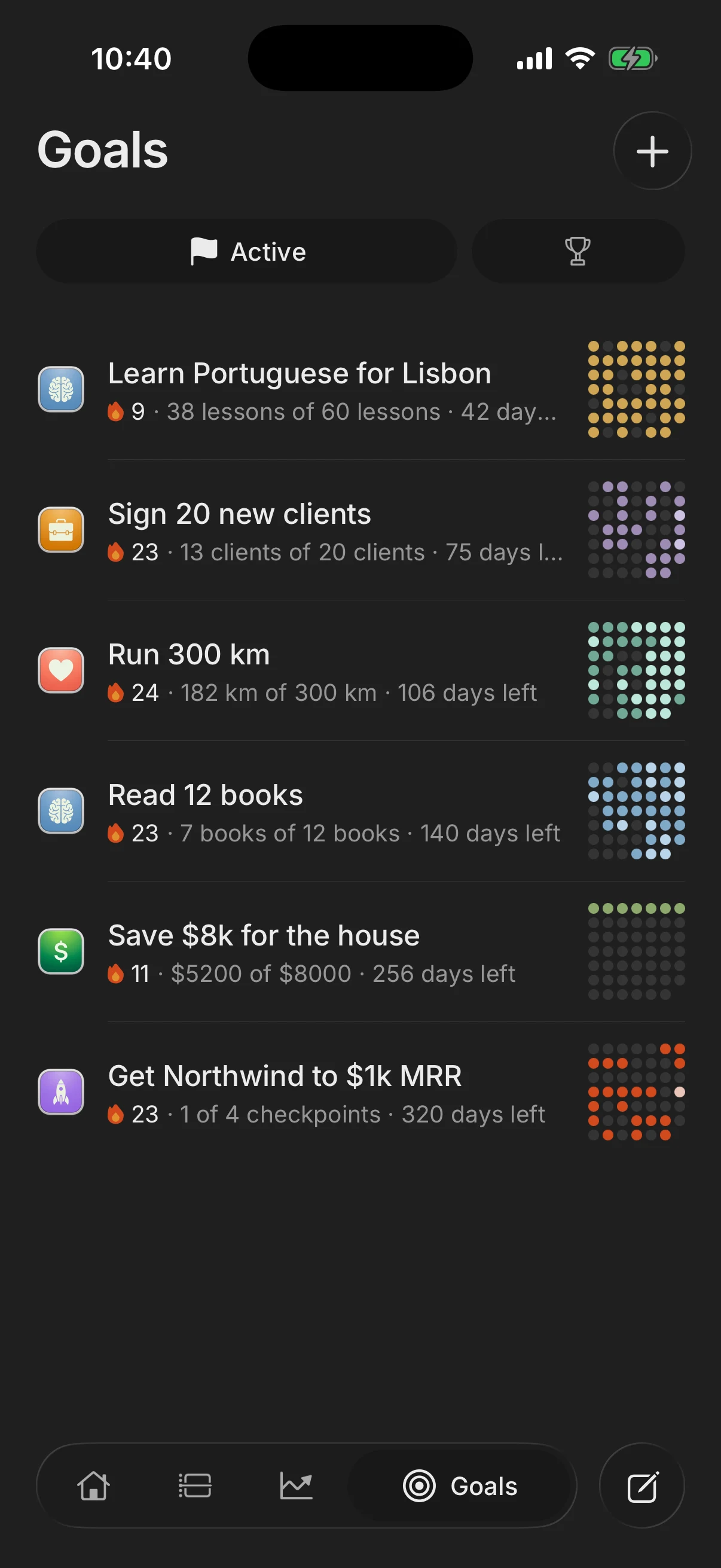
Look at each goal you are working toward and ask: what is the one step this week that would move it forward? From those, choose two or three. These are the week's priorities, and everything else is secondary.
- Write them as outcomes, not activities. "Send the first draft of chapter 3 to the editor" can be finished. "Work on the book" cannot.
- Size them at 2 to 6 hours each. Smaller, and it is just a task. Bigger, and it needs splitting into a part for this week and a part for later.
- Keep it to three at most. Five weekly priorities is a to-do list with a new name.
- Include life, not just work, if a goal there matters: three runs, a call with a parent, the tax forms.
If your goals are vague ("get healthier", "grow the business"), this step will feel hard. That is a goal problem, not a planning problem, and our guide on turning goals into tasks shows how to break one down.
Step 4: block time for each priority
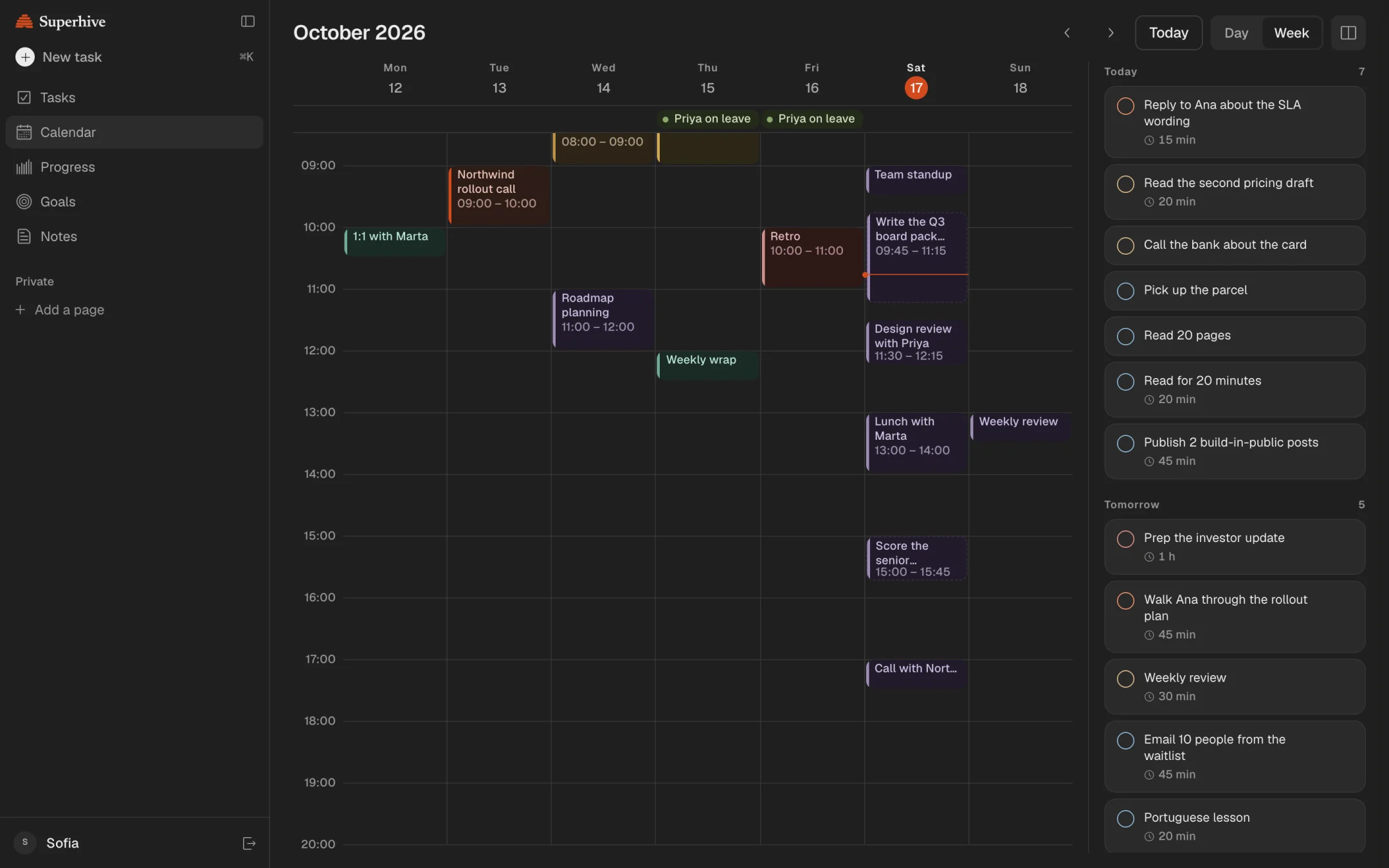
Now give each priority time on specific days, in your best hours. You are not planning every hour. You are reserving the blocks the priorities need, so meetings and small requests cannot take them. Put them on your calendar, leave the details to each morning's daily plan, and keep a half-day near the end of the week unplanned for whatever slips.
An example. The priorities are: ship the client proposal (about 5 hours), prepare Thursday's workshop (about 3 hours) and run three times, for a health goal.
| Day | Already fixed | Priority blocks |
|---|---|---|
| Monday | Team meeting 10:00 to 11:00 | Run at 7:00; proposal 14:00 to 16:00 |
| Tuesday | Nothing | Proposal 9:00 to 11:00; workshop prep 14:00 to 15:30 |
| Wednesday | Meetings 10:00 to 14:00 | Run at 7:00; workshop prep 8:30 to 10:00 |
| Thursday | Workshop 10:00 to 12:00 | Final pass on the proposal 14:00 to 15:00, then send |
| Friday | Weekly planning at 16:00 | Run at 7:00; open 13:00 to 16:00 for overflow |
Wednesday has four hours of meetings, so it only gets the short block that has to happen before Thursday. Friday afternoon is open on purpose. If the week goes to plan, it becomes time for the next thing on the list; if it does not, it is where the week recovers.
Keeping the plan alive until Friday
- Start each day from the weekly plan. The morning plan places the day's priority block first, then fills in the rest.
- Check in on Wednesday. Five minutes: is any priority at risk? If so, move a block, cut the scope or ask for more time now, while asking is still cheap.
- When the week blows up, protect one. A crisis that eats three days still leaves room for one priority if you guard its blocks. Move the others to next week on purpose instead of letting them fade.
- Close each day. A short shutdown ritual moves unfinished work to a specific day, so Friday's look back starts from an honest list.
When weekly planning fails, it is usually one of the steps done in reverse: skipping the look back, choosing six priorities, or choosing priorities without reserving any time for them.
The weekly plan answers what matters and roughly when. The daily plan answers the exact hour. Do not ask one to do the other's job.
Paper, calendar or an app
A notebook and your calendar are enough to start: priorities on paper, blocks on the calendar. The friction is that goals, tasks and calendar live in three places, so part of every session goes to copying between them.
Superhive keeps them together. Each goal has its milestones, a pace and the tasks under it, so step 3 starts from a list that already exists. The calendar shows the next two weeks with each day's tasks and events, the web app lays the week out as blocks on a bigger screen, and the progress screen gives you a weekly momentum score compared with your own past weeks, a ready-made start for the look back. All of it is on the free plan.
Questions people ask
What day is best for weekly planning?
Friday afternoon or Sunday evening, for most people. Friday works best for work because the week is still fresh; Sunday suits people who plan work and home together. The best day is the one you will keep, so put it on your calendar.
How long should weekly planning take?
20 to 30 minutes once it is a habit. The first few sessions often take 45 minutes, because there is more to clear up.
What is the difference between a weekly review and weekly planning?
The review looks back: what got done, what is loose, how your estimates held up. The planning looks ahead and sets next week's priorities. The weekly review David Allen popularized in Getting Things Done covers both, and doing them in one sitting, review first, works well.
How many priorities should I set for the week?
Two or three. Each should take 2 to 6 hours and be written as an outcome you can finish, such as "send the draft to the editor".
What if I miss my weekly planning session?
Do a 10-minute version on Monday morning: check the week's calendar and choose one priority. A short plan beats none, and the full session can wait until next week.
Should I plan every hour of my week?
No. Reserve blocks for your priorities and a few batches of small work, and leave the rest to each day's plan. A week planned to the hour breaks on Monday.
Keep reading
- How to plan your day: a 10-minute routine, step by stepPlan your day in 10 minutes: pick 3 tasks, estimate them and give each a time around what is fixed. With an example day and what to do when the plan breaks.
- How to break down goals into tasks you actually doBreak a goal into milestones, a weekly pace and one next task with a day and a time. A step-by-step method, a worked example and why most goals stall.
- Time blocking: how to plan your day in blocksTime blocking gives every task a start time and a length on your calendar. How to do it in 10 minutes a day, with an example day and the mistakes to avoid.
- Shutdown ritual: how to end the workday and stop thinking about workA shutdown ritual is a 10-minute routine that closes your workday. The steps, an example and why it helps you stop thinking about work in the evening.