GuidesLast updated 2 November 20267 min read
How to break down goals into tasks you actually do
To break down a goal, work backwards from the finish: write the outcome with a date, split it into 3 to 5 milestones you can check, turn the current milestone into a weekly pace, and give the next task a day, a time and a length. Most goals do not die from a lack of motivation. They die in the gap between the goal and the calendar, where nothing says what to do on Tuesday.
Why most goals stall between the goal and the calendar
A goal like "get in shape" or "grow the business" is a direction, not something you can do. On any given day nothing on your calendar says what to do about it, so whatever is urgent wins, every day, and by March the goal is a vague sense of guilt. The problem is rarely willpower. The goal was never translated into actions with a time attached.
Psychologists have a name for the fix. Peter Gollwitzer's research on implementation intentions found that people who decide when and where they will act ("Monday at 7:00, before work, I run 3 km") follow through more often than people who only commit to the goal. Breaking a goal down is how you reach that level of detail without having to invent it every morning.
The four levels: goal, milestones, pace, next task
Every goal that gets done passes through four levels, and each one answers a different question. Skip a level and the goal stalls right there.
| Level | Question it answers | Example |
|---|---|---|
| Goal | What, and by when? | Run a half marathon on April 12 |
| Milestones | What is true at each stage? | 10 km without stopping by February 1 |
| Weekly pace | How much, every week? | 3 runs a week, long run up 1 km a week |
| Next task | What do I do, and when? | Tuesday 7:00, 30-minute easy run |
Most people jump from the goal straight to a burst of tasks, keep it up for two weeks, then drift. Without milestones they cannot tell whether they are on track, and without a pace there is no answer to how much is enough this week, so a quiet week feels like failure and an ambitious one feels like it should last forever.
How to break down a goal, step by step
- Write the outcome with a date. "Get fit" becomes "run a half marathon on April 12". If you cannot say how you will know it is done, you cannot plan it.
- Check that it fits. Count the weeks to the date and the hours a week you really have. A goal that needs 10 hours a week from someone with 3 free hours is a wish. Change the date or the scope now, not in month two.
- Work backwards into 3 to 5 milestones. Start at the finish and ask what has to be true just before it, then just before that. Each milestone should be checkable: a number, a finished thing or a clear yes or no.
- Turn the current milestone into a weekly pace. Divide what is left by the weeks left. 40,000 words in 20 weeks is 2,000 words a week, which is four sessions of 500.
- Write the next task as an action. "Work on the book" is a project. "Write 500 words of chapter 3" is a task: it starts with a verb, you can finish it in one sitting, and you know when it is done.
- Give it a day, a time and a length. This is the step most goal-setting advice skips, and it is where most goals are lost. A task with a slot on the calendar is much harder to skip than one waiting on a list.
- Review once a week. Compare progress with the pace, adjust, and schedule next week's sessions. Our weekly planning guide covers the 20-minute version.
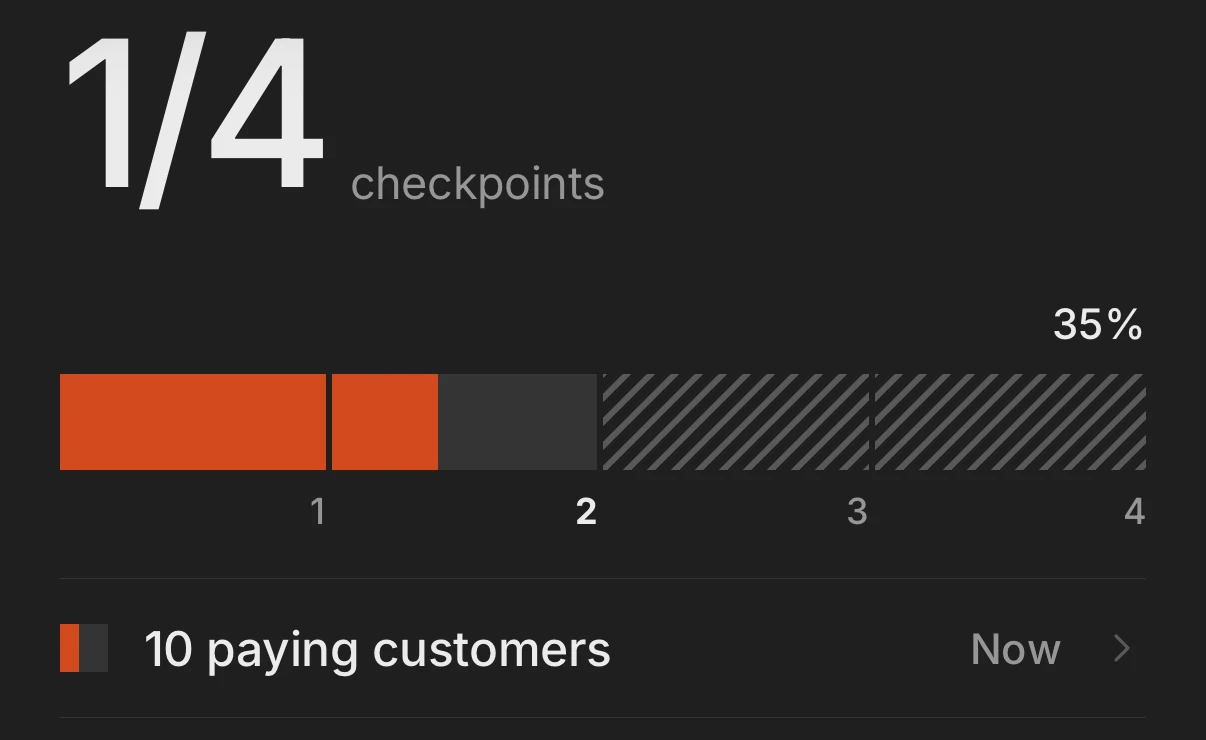
A worked example: from a goal to this week's calendar
Say the goal is to land a job as a product designer within 16 weeks. The offer itself is not fully in your control, so the milestones are built from things that are: work published, people contacted, applications sent.
| Milestone | Done when | Weekly pace | Weeks |
|---|---|---|---|
| Portfolio ready | 3 case studies online | 1 case study every 2 weeks | 1 to 6 |
| Network warmed up | 20 conversations with designers | 3 conversations a week | 4 to 10 |
| Applications out | 40 tailored applications sent | 6 a week | 8 to 14 |
| Interview ready | Portfolio talk rehearsed 5 times | 1 rehearsal a week | 10 to 16 |
Week 1 then needs only three tasks, each with a slot:
- Monday, 19:00 to 20:00: pick the 3 projects and gather the files.
- Wednesday, 19:00 to 20:30: outline case study 1 (problem, process, result).
- Saturday, 10:00 to 12:00: write the first draft of case study 1.
That is under five hours, it fits around a full-time job, and on Sunday you know exactly whether week 1 happened.
How to set a pace you can keep
- Plan for an 80 percent week. Illness, travel and deadlines happen. If the plan only works when every week goes perfectly, it does not work. Leave a catch-up week every 4 to 6 weeks.
- Count sessions, not hours. "3 sessions of 45 minutes" is easier to place on a calendar and easier to check than "about 2 hours".
- Plan around inputs, watch the outputs. You control words written, runs done and calls made. Weight, revenue and job offers follow later and less predictably, so track them, but build the week around what you do.
- When you fall behind, recalculate. Divide what is left by the weeks left again. If the new pace does not fit, move the date or cut the scope. Doubling up next week rarely works.
- Keep 1 to 3 goals active. Each active goal needs hours every week. Three goals at 3 hours each is 9 hours, more than most people have spare after work.
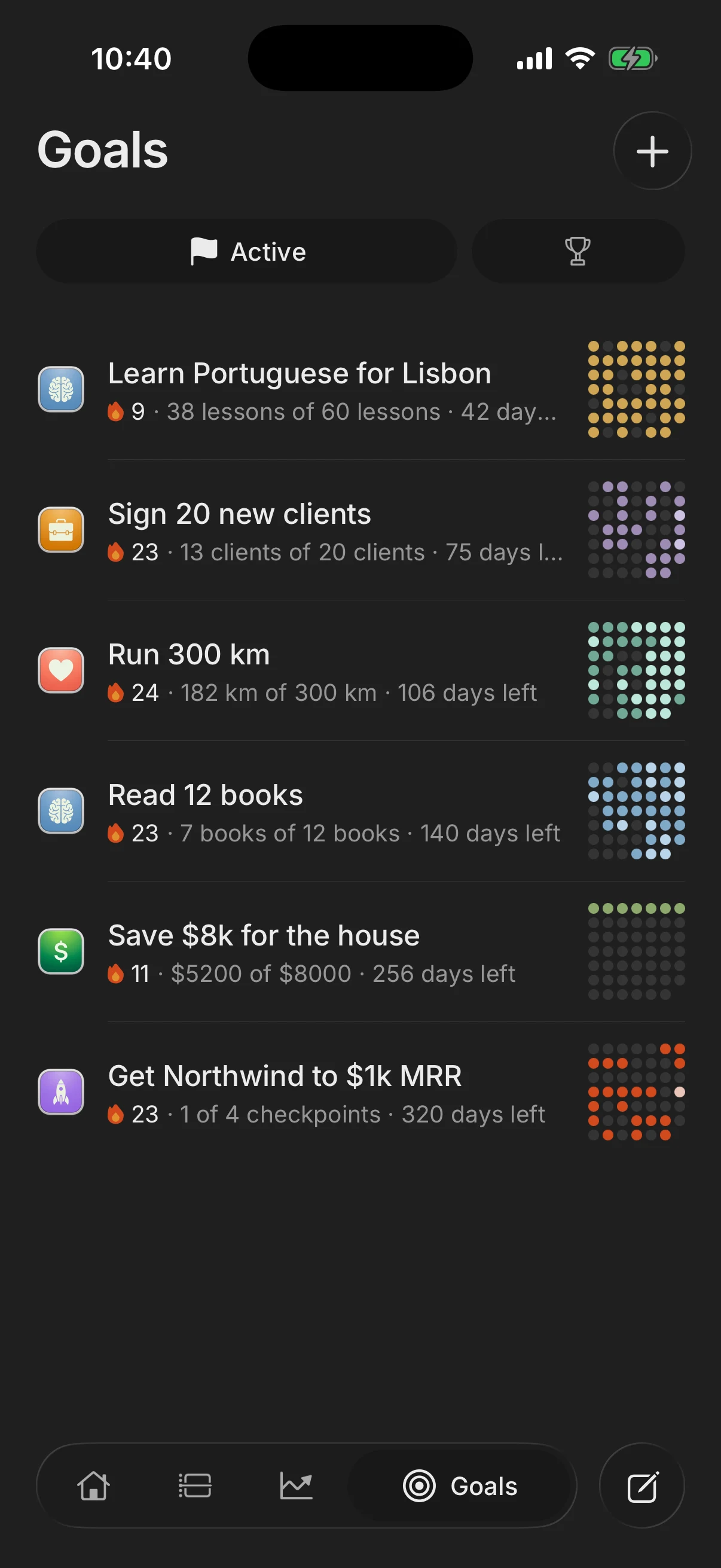
If a goal has no task with a day and a time this week, it is not an active goal. It is a wish with a deadline.
Common mistakes when breaking down goals
- Milestones you cannot check. "Get better at Spanish" never ends. "Hold a 20-minute conversation with a tutor" does.
- Tasks that are projects in disguise. "Do the website" sits on a list for weeks. If a task takes more than one sitting, split it until the first piece takes 25 to 90 minutes.
- Planning every step up front. Detail the current milestone only. The later ones will change once you learn from the first, so keep them to one line each.
- Goals that live far from your week. A goal in a notes app and tasks in a calendar drift apart on their own. Whatever you use, the next task should be one tap from the goal it serves.
Keeping goals and tasks in one place
A notebook works: one page per goal with its milestones, and this week's tasks copied into your diary. So does a spreadsheet with a row per milestone. The weak point of both is the copying. The goal lives in one place, the week in another, and the link between them lives in your head.
Superhive is built on that link. Every task can belong to a goal, and each goal has milestones with their own targets plus, once you give it a date, a pace that shows whether you are moving fast enough. Tasks with a length land on your day as time blocks in the free time around your events, and each goal lists the tasks under it, so the next step is never far away. Goals, milestones and the day view are on the free plan, and you can share a goal with someone and assign them tasks. Pro adds AI-written goal plans, if you would rather edit a draft than start from a blank page.
Questions people ask
How do you break a big goal into smaller goals?
Work backwards from the finished result. Ask what has to be true just before the goal is done, then before that, until you have 3 to 5 milestones you can check, then set a weekly pace for the current one.
What is the difference between a goal and a task?
A goal is an outcome with a date, such as running a half marathon in April. A task is a single action you can finish in one sitting, such as a 30-minute run on Tuesday. If you cannot finish it in one go, it needs splitting.
Are SMART goals enough?
SMART (specific, measurable, achievable, relevant, time-bound) is a good checklist for writing the goal itself. It does not tell you what to do this week, which is the job of milestones, a pace and a scheduled next task.
How many goals should I work on at once?
One to three. Each active goal needs time every week, and most people only have a few spare hours after work and family.
What should I do if I fall behind on a goal?
Recalculate the pace from what is left and the weeks left. If it no longer fits, move the date or shrink the scope rather than trying to double up next week.
How often should I review my goals?
Weekly for the pace and next week's tasks, which takes about 20 minutes. Every month or quarter, step back and ask whether each goal still matters to you.
Keep reading
- How to plan your week: a 30-minute weekly planning sessionWeekly planning in 30 minutes: look back at last week, look ahead, pick 2 or 3 priorities tied to your goals and block time for them. With an example week.
- Time blocking: how to plan your day in blocksTime blocking gives every task a start time and a length on your calendar. How to do it in 10 minutes a day, with an example day and the mistakes to avoid.
- How to organize your studies: a study schedule that worksPlan backwards from exam dates, use spaced repetition and active recall, and turn it into a weekly study schedule. With a sample week for exam season.
- The Eisenhower matrix: how to use it, with examplesThe Eisenhower matrix sorts tasks into four quadrants: do, schedule, delegate, delete. Real examples for work and school, a 5-minute method and its limits.