GuidesLast updated 2 November 20267 min read
How to plan your day: a 10-minute routine, step by step
To plan your day, take 10 minutes before it starts to empty your head onto one list, look at what is already fixed, pick at most three tasks that matter, estimate each one and give it a time in the gaps. Leave about a fifth of your free time unplanned, because something always runs over. Do it first thing in the morning or the night before; what matters is that you decide what the day is for before your inbox does.
Why 10 minutes of planning is worth it
An unplanned day still gets planned, just by other people. The first email sets the first task, the next message sets the second, and by 4 p.m. you have been busy all day without touching the thing that mattered. Planning is the 10 minutes where you choose instead.
A good daily plan does three jobs. It decides what matters today while you are calm, not when something urgent is shouting. It checks whether that work fits in the hours you really have, which most to-do lists never do. And it removes the small decision between tasks, the "what now?" that costs a few minutes and often ends with your phone in your hand.
The 10-minute routine, step by step
Do the steps in this order. Each one is here because skipping it is how daily plans usually fail.
- Empty your head (2 minutes). Write down everything on your mind: tasks, errands, replies you owe, worries. One list, not five. You cannot choose between things you are holding in memory, and David Allen's point in Getting Things Done still stands: your head is for having ideas, not for storing them.
- Look at what is fixed (1 minute). Meetings, calls, classes, the school run, lunch, the commute. Add up the free hours that are left. This is the step people skip, and it is why they plan eight hours of work into a day that has four.
- Pick one to three tasks that matter (2 minutes). Ask: if only this gets done today, will the day have counted? Anything due today is in automatically. After that, prefer work that moves a goal forward over work that only feels urgent. If you cannot tell which is which, the Eisenhower matrix is a quick filter.
- Estimate each one, then add a quarter (2 minutes). Write a length next to every task you picked: 30 minutes, 90 minutes, 2 hours. Then add 25 percent, because most estimates are optimistic. A task without a length cannot be checked against the clock.
- Give each task a time (2 minutes). Put the hardest task in your best hours, usually early, before messages pile up. Small things (replies, forms, quick calls) go together into one 30-minute batch instead of leaking into everything. This is time blocking at its simplest.
- Check that it fits (1 minute). Add up the planned work. If it is more than about 80 percent of your free hours, cut or move something now. Deciding at 9 a.m. what will not happen today is calm. Discovering it at 5 p.m. is not.
Ten minutes, six questions: what is on my mind, what is fixed, what matters, how long, when, and does it fit.
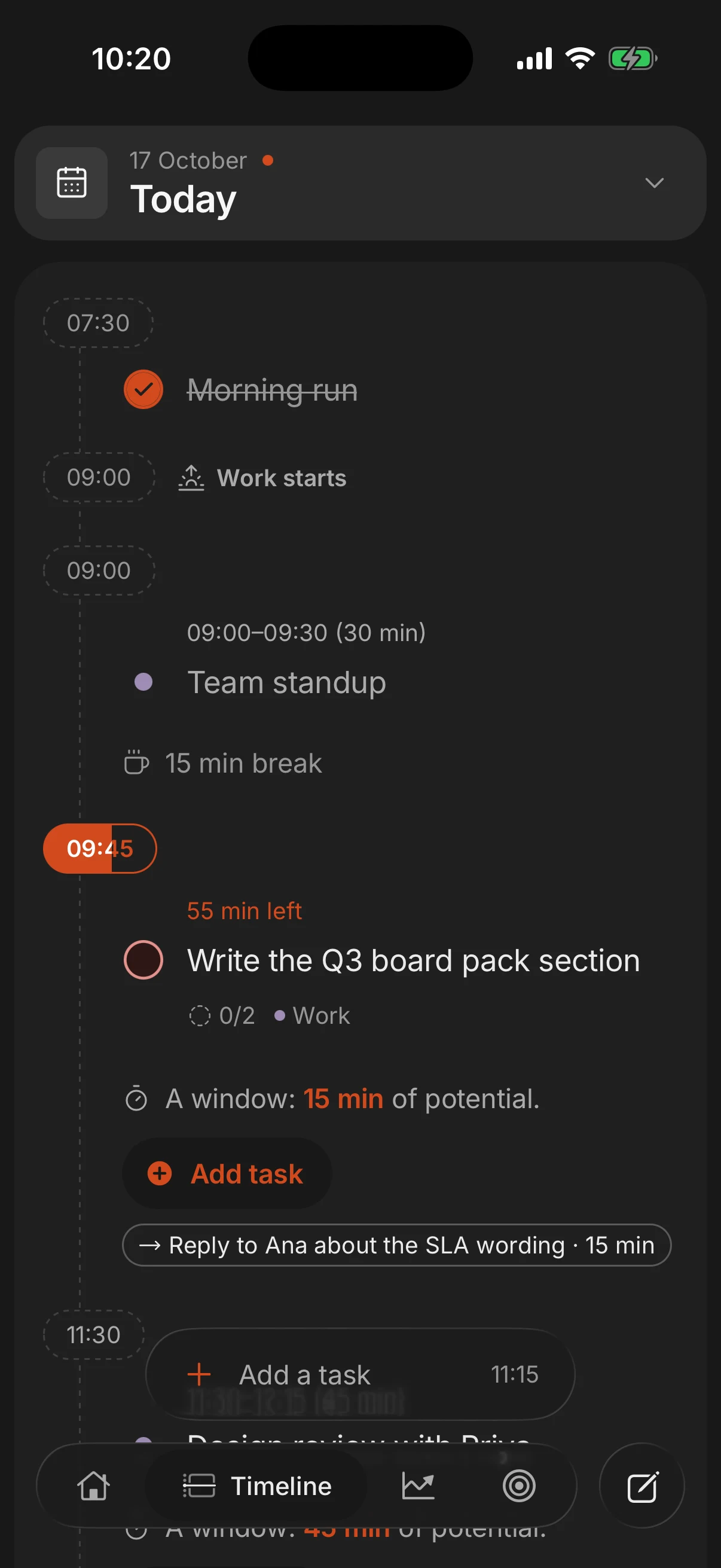
An example: planning a real Tuesday
It is 8:50 on a Tuesday. The list has 12 items on it: finish the budget draft, reply to the supplier about a delayed order, book flights for March, submit an expense report, renew the car insurance, call the bank, read a report a colleague sent, and five smaller things.
The fixed things are a team meeting from 11:30 to 12:30, lunch from 13:00 to 13:45 and a dentist appointment at 16:30, which means leaving at 16:15. That leaves about 5.5 free hours, so roughly 4.5 hours of planned work at most.
Three tasks matter today: the budget draft (estimated at 1 hour 45, so 2 hours 15 with the margin), the supplier reply, because the order affects a client, and the flights, because prices go up. The day ends up like this:
| Time | Block | Why it is there |
|---|---|---|
| 8:50 to 9:00 | Plan the day | The routine above |
| 9:00 to 11:15 | Budget draft | The task that matters most, in the best hours |
| 11:15 to 11:30 | Break | Room for the draft to run over |
| 11:30 to 12:30 | Team meeting | Fixed |
| 12:30 to 13:00 | Email, including the supplier reply | Replies done together, not all morning |
| 13:00 to 13:45 | Lunch | Fixed |
| 13:45 to 14:15 | Book the March flights | Waiting costs money |
| 14:15 to 15:00 | Admin batch: expenses, insurance, bank | Small tasks in one go |
| 15:00 to 16:15 | Open | Overflow, or the next thing on the list |
| 16:15 | Leave for the dentist | Fixed |
Planned work: 4 hours, with 75 minutes open and a 15-minute break. The other six items did not disappear. The colleague's report got Thursday morning, two small things were deleted because they no longer mattered, and three stay on the list. Choosing what not to do today is half of the plan.
Morning or the night before
Both work. The difference is what you know when you plan.
- The night before suits people whose mornings are rushed or who start early. You wake up already knowing the first task, and you plan while the day's context is still fresh. It fits naturally at the end of a shutdown ritual.
- The morning suits people whose days change overnight: new messages, a sick child, a bad night's sleep. You plan with real information about the day you are actually going to have.
- Both, split in two, is what many people settle on: a rough plan at the end of the workday (pick tomorrow's first task), then 5 minutes in the morning to confirm it and fit in whatever arrived overnight.
Whichever you choose, plan before you open email or messages. Once you read them, their priorities start to feel like yours.
When the day breaks: how to recover
Most planned days break somewhere. A client calls, a meeting runs over, a task turns out to be three times bigger. The plan has not failed at that point. It is what lets you recover in two minutes instead of drifting until evening.
- Stop for two minutes before reacting any further. Look at the clock and count the hours left.
- Ask which of your three tasks still matters today. Usually one does. Give it the best block that is left.
- Shrink it if you need to. If the 2-hour draft no longer fits, do the first 45 minutes: the outline, the first section. Some progress beats a clean postponement.
- Move the rest to a specific day, not to "later". A task without a date tends to come back as tomorrow's emergency.
- If the day is truly gone, call it. Write down the first step for tomorrow and stop planning against a day that no longer exists.
A plan you change at 11 a.m. is still working. A plan you abandon at 11 a.m. hands the rest of the day to whatever shouts loudest. Two small habits keep it alive: a 30-second look at the plan at lunch, which catches a drifting afternoon while there is still time, and carrying unfinished work forward on purpose, each item with a date, instead of rewriting the list from scratch every morning.
Paper, calendar or an app
The routine works on anything. A notebook is fast and quiet, but it cannot remind you or move unfinished tasks for you. A calendar like Google Calendar already holds your meetings, but your tasks live somewhere else, so you copy them across every morning. A planner app keeps both in one place, which turns steps 4 to 6 from arithmetic into a glance.
Superhive is built around this routine. You type tasks in plain words, like "call the bank friday 3pm", and it reads the date and time for you. Each task can belong to a goal, tasks with a length land on a timeline in the free time around your events, and when you close the day the shutdown shows what got done and lets you send what is left to tomorrow or another day. All of that is on the free plan.
Questions people ask
What is the best way to plan your day?
Spend 10 minutes before the day starts: list everything, check what is fixed, choose at most three tasks that matter, estimate them and give each a time. Leave about 20 percent of your free time unplanned.
Should I plan my day the night before or in the morning?
Either works. The night before means you wake up knowing your first task; the morning lets you account for whatever changed overnight. Many people sketch the plan at the end of the workday and confirm it in 5 minutes the next morning.
How many tasks should I plan in a day?
One to three tasks that matter, plus small things batched together. As a check, planned work should fill no more than about 80 percent of the free hours you have after meetings.
What should I do with tasks I did not finish?
Give each one a new, specific day, or delete it if it no longer matters. Doing this at the end of the day, as part of a shutdown ritual, keeps unfinished work from quietly piling up.
How do I plan my day when I get interrupted all the time?
Plan less. Protect one block of 60 to 90 minutes early in the day for the task that matters, batch everything else, and leave 30 to 40 percent of the day open for the interruptions you know will come.
Keep reading
- Time blocking: how to plan your day in blocksTime blocking gives every task a start time and a length on your calendar. How to do it in 10 minutes a day, with an example day and the mistakes to avoid.
- How to plan your week: a 30-minute weekly planning sessionWeekly planning in 30 minutes: look back at last week, look ahead, pick 2 or 3 priorities tied to your goals and block time for them. With an example week.
- Shutdown ritual: how to end the workday and stop thinking about workA shutdown ritual is a 10-minute routine that closes your workday. The steps, an example and why it helps you stop thinking about work in the evening.
- The Eisenhower matrix: how to use it, with examplesThe Eisenhower matrix sorts tasks into four quadrants: do, schedule, delegate, delete. Real examples for work and school, a 5-minute method and its limits.