GuidesLast updated 2 November 20267 min read
Structured app alternative: Superhive vs Structured, compared honestly
If you like Structured's visual timeline but want each task tied to a long-term goal, a web app on the same account and a record of progress over weeks, Superhive is the closest alternative: a similar day timeline, plus goals with milestones, a daily shutdown and a streak, with a free plan. If visual cues and timers designed for neurodivergent minds matter most, look at Tiimo; if your work lives in Asana, Jira and Gmail, look at Sunsama. And if Structured already covers your day, stay with it: it is one of the best-designed day planners on the iPhone.
What Structured does well
Structured earns its reputation. It turns the day into one vertical timeline where each task is a colored block with an icon, placed between what comes before and after it, so you can tell at a glance whether 3 p.m. is free. Most planners give you a list and leave you to imagine the day. Structured draws it.
- The timeline. Your day in order, from morning to night, on one scroll. Few apps make a day this easy to read.
- Simplicity. A task needs a name, a time and a length. You do not have to set up projects, labels or filters before the app is useful.
- The energy monitor. It helps you see how demanding a day is before you are in it, so a draining afternoon is something you notice in the morning rather than at 4 p.m.
- AI task creation. Describe what you need to do in plain words and Structured turns it into tasks.
Why people look for a Structured alternative
- Busy days that do not add up. Structured plans today very well, but its tasks are not tied to long-term goals. You can fill months of tidy timelines and still not move the thing you care about most.
- Planning at a computer. Structured is iPhone first. It has a web version, so check that it covers how you plan before relying on it at a desk all day.
- Android. There is an Android app, but it has fewer features than the iPhone one. If you switch phones, or plan with someone on Android, the gap shows.
- Closing the day. Structured is built around planning today. Some people also want a short evening ritual that sorts done from not done, and a streak or score that shows the habit holding over weeks.
- Price where you live. Structured Pro is sold as a subscription or a one-time purchase, and prices vary a lot by country. Compare what your own store shows.
Structured vs Superhive at a glance
Both are day planners built on a timeline, so the differences are in what surrounds the day. Prices are as of November 2026 and vary by region, so check your store.
| What you get | Structured | Superhive |
|---|---|---|
| Day view | Visual timeline with icons and colors | Timeline with tasks as blocks around events, or a calendar grid |
| Long-term goals | Not built in | Goals with milestones, a pace and their tasks |
| Adding tasks | AI turns a description into tasks | Quick add reads date, time, priority and goal from plain words |
| End of the day | Focused on planning today | Daily shutdown: what got done, what rolls to tomorrow |
| Progress over time | Not its focus | A streak and a weekly momentum score |
| Energy | Energy monitor | No energy view |
| Platforms | iPhone first, Android with fewer features, web | iPhone, Android and web on one account |
| Price | Free core; Pro by subscription or lifetime, varies by region | Free plan; Pro $8.99 a year, $2.99 a month or $24.99 once |
In short: Structured draws a single day better than almost anything else. Superhive keeps the timeline, then ties each task to a goal and closes every evening with a shutdown, on iPhone, Android and the web. All of that is in the free plan, so you can test the difference without paying.
The main difference: tasks that belong to a goal
A timeline answers when. It does not answer why this task and not another. That is the gap people feel after months of well-planned days that add up to nothing in particular.
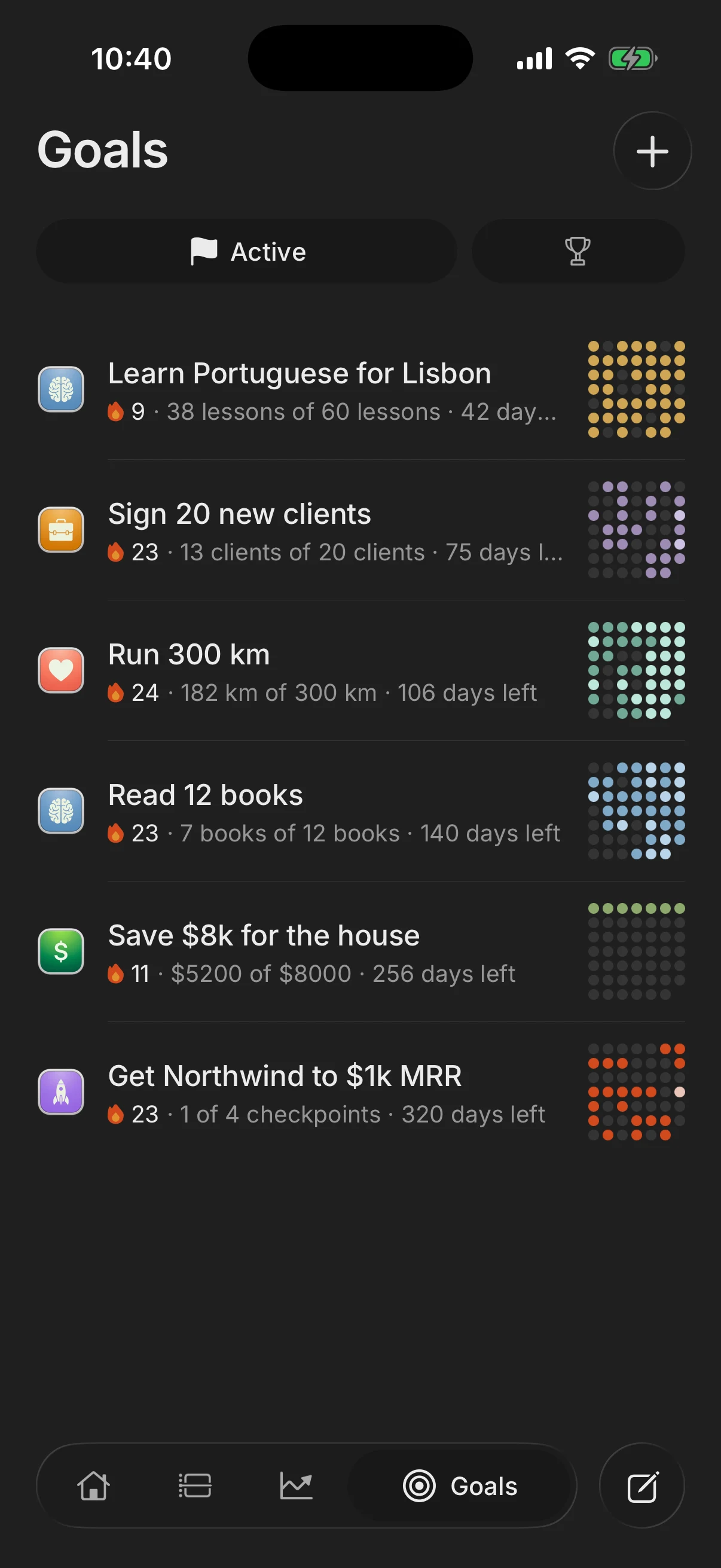
In Superhive a task can sit under a goal. A goal can have a date, milestones on the way and a pace that tells you how fast you need to move to make the date, and its tasks are the ones that turn up on your day. Say the goal is Run a half marathon in March: the first milestone is 10 km without stopping by January, and each training run is a task under that goal that lands on your timeline like any other block. Open the goal and you see its streak, its progress and the days left.
You can imitate this in Structured with one color per goal. It holds up for one goal; with three or four, the link between today and the goals lives only in your head. Our guide to turning goals into daily tasks covers the method in any app.
The day itself: how the two timelines differ
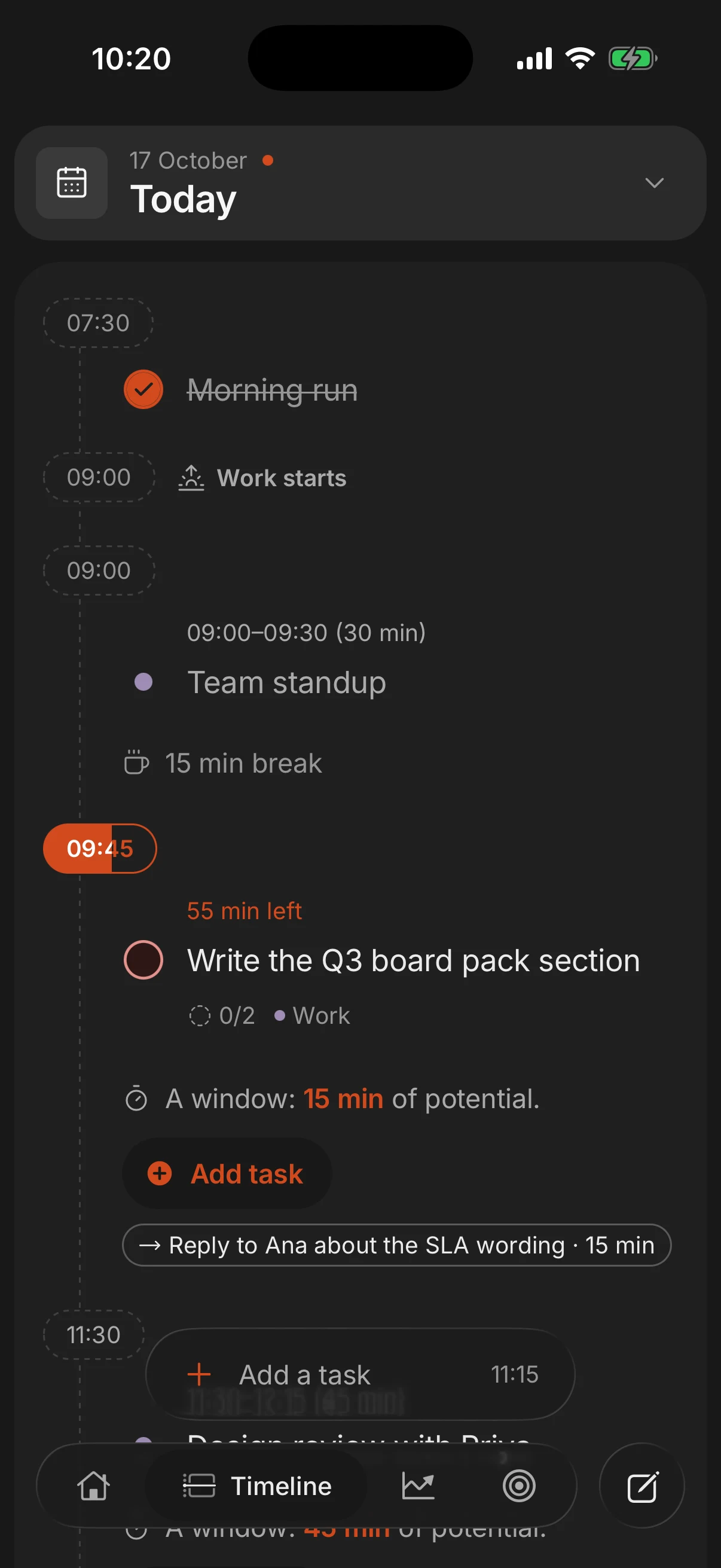
Day to day, the two apps feel close: tasks and events in order, free time in plain sight. The differences are in the details.
- Tasks fill the gaps. In Superhive, a task with a length lands as a block in the free time around your events. If you prefer a classic calendar, switch the day view to a grid.
- Nothing falls off. The daily shutdown shows what got done and moves what did not to tomorrow. On Pro, replan moves everything left undone to another day in one go.
- Your calendar. Superhive Pro imports Google Calendar and the phone's own calendars, so events sit on your day, and it can write scheduled tasks back to Google Calendar as blocks as long as the task.
- Focus. Pro adds focus sessions, a timer for one task, and Super focus, which blocks distracting apps on the iPhone during a session or on a schedule.
Other Structured alternatives worth a look
- Tiimo is a visual planner designed with neurodivergent people in mind. If visual cues and timers are what keep you going, it is the closest in spirit to Structured.
- Sunsama suits knowledge workers whose tasks live in Asana, Trello, Notion, Jira or Gmail, pulled into a guided daily planning ritual. Subscription only, roughly $16 to $25 a month. See Sunsama alternatives.
- TickTick puts a calendar view, a habit tracker and a Pomodoro timer in one app for around $50 a year. More features, and more on the screen. See TickTick alternatives.
For the wider field, see the best planner apps.
When to stay with Structured
- You plan one day at a time and do not want goals or scores around it. Structured's narrow focus is a feature, not a gap.
- The energy monitor shapes your day. Superhive has nothing like it.
- You bought the lifetime version. Switching means paying again for something you already own.
- You want the simplest planner possible. Superhive also has goals, notes, shared goals and progress, and more is not always better.
Switch for a reason you feel every week, like goals that never move or a computer you plan at. Do not switch for a longer feature list.
How to switch in an afternoon
- Write down the 2 or 3 goals your days should serve, and create those first.
- Move only the next 2 weeks of tasks, each under its goal. There is no import from Structured, but quick add reads the date, time, priority and goal from what you type.
- Give each task a length so it lands on the timeline as a block, and leave about 20 percent of the day free.
- Close each day with the shutdown for a week. If your days feel more pointed, stay. If you miss Structured, go back; the free plan cost nothing.
Superhive is free on iPhone, Android and the web, with no ads. The yearly Pro plan comes with a 3-day free trial.
Questions people ask
Is there a free alternative to Structured?
Yes. Superhive's free plan includes the timeline, goals with milestones, the daily shutdown and progress, with no time limit. If you only need to block time, Google Calendar is free too.
Is Structured available on Android and the web?
Yes, Structured has Android and web versions, though the Android app has fewer features than the iPhone app. Superhive works on iPhone, Android and the web with one account, and changes sync in seconds.
Can Structured track long-term goals?
Not directly. Structured plans days, and its tasks are not tied to long-term goals. Superhive is built around goals with milestones and a pace, with their tasks on your day.
What is the difference between Structured and Tiimo?
Both are visual day planners. Tiimo is designed with neurodivergent people in mind and leans on visual cues and timers, while Structured is a clean timeline meant for anyone.
How much does Superhive cost compared with Structured?
Superhive has a free plan; Pro is $8.99 a year, $2.99 a month or $24.99 once. Structured also has a free core, but its Pro prices vary a lot by region, so compare in your store.
Keep reading
- A cheaper Sunsama alternative that keeps the daily ritualSunsama costs about $16 to $25 a month with no free plan. What it does well, why people switch, and alternatives that keep the daily ritual for far less.
- The best daily planner apps in 2026, compared honestlySuperhive, Structured, Sunsama, Motion, Todoist, TickTick, Notion and Google Calendar compared: who each is for, what it does best, its catch and its price.
- How to break down goals into tasks you actually doBreak a goal into milestones, a weekly pace and one next task with a day and a time. A step-by-step method, a worked example and why most goals stall.
- Time blocking: how to plan your day in blocksTime blocking gives every task a start time and a length on your calendar. How to do it in 10 minutes a day, with an example day and the mistakes to avoid.